

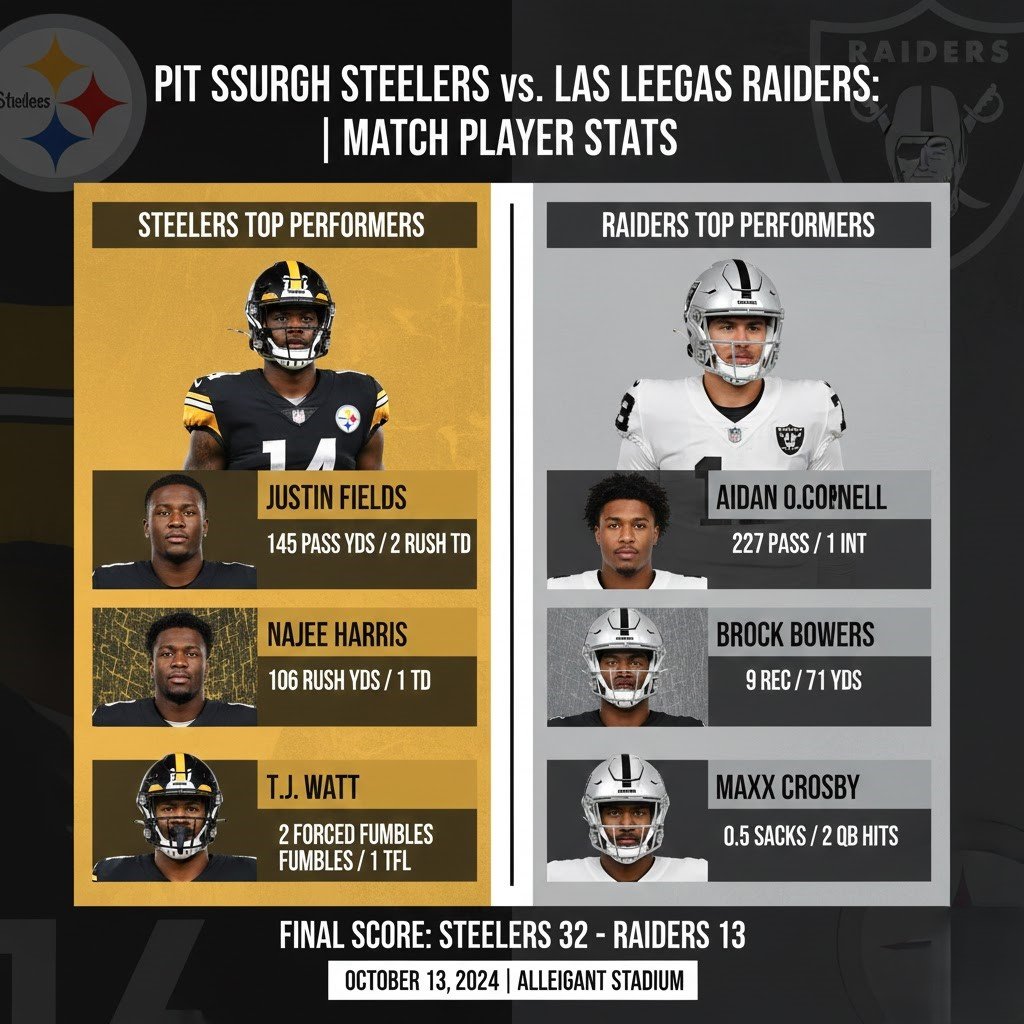
The matchup between the Pittsburgh Steelers and the Las Vegas Raiders is not merely a game on the NFL calendar; it is a collision of legacies. Spanning over five decades, this rivalry has defined eras of professional football, from the gritty 1970s to the glitzy, high-tech atmosphere of Allegiant Stadium in 2024. Every snap, every tackle, and every touchdown is steeped in history, making it one of the most compelling and unpredictable fixtures in the league.
In their most recent high-stakes encounter on October 13, 2024, the Steelers traveled to Las Vegas and delivered a statement 32–13 victory. This article provides an exhaustive breakdown of the player statistics, historical context, advanced analytics, and tactical nuances that define this AFC classic, offering insights for both die-hard fans and savvy bettors.
2024 Game Recap: The Allegiant Stadium Takeover
The Week 6 clash of the 2024 NFL season saw the Pittsburgh Steelers snap a two-game losing streak with a dominant performance against the Las Vegas Raiders. The narrative leading into the game questioned Pittsburgh’s offensive consistency and whether their vaunted “Steel Curtain” defense could truly dominate on the road. The answer, emphatically, was yes. Steelers Nation famously turned Allegiant Stadium into a de facto home game, and the team on the field delivered.
The Final Scoreboard: Quarter-by-Quarter Breakdown
| Quarter | 1st | 2nd | 3rd | 4th | Final |
| Pittsburgh Steelers | 3 | 9 | 10 | 10 | 32 |
| Las Vegas Raiders | 7 | 0 | 0 | 6 | 13 |
Key Game Flow Highlights:
- Early Raiders Lead: The Raiders started strong, with Alexander Mattison punching in a 3-yard touchdown run to give them an early 7-3 lead, electrifying the home crowd. This would be the only time Las Vegas held the lead.
- Steelers Grind Back: Pittsburgh chipped away with a field goal and two Justin Fields rushing touchdowns, establishing a 12-7 lead by halftime. Their control of the trenches became evident as the game progressed.
- The Second Half Surge: The pivotal third quarter saw the Steelers outscore the Raiders 10-0, featuring a crucial Najee Harris touchdown run and a Chris Boswell field goal. This put the game firmly out of reach.
- Defensive Masterclass: Throughout the second half, the Steelers’ defense, particularly T.J. Watt, forced turnovers that directly led to Pittsburgh’s scoring drives, preventing any Raiders’ comeback attempt.
Offensive Player Statistics: Performance Analysis
The Steelers’ 2024 victory was built on a foundation of efficient quarterback play and a physically dominant running game. For the Raiders, despite moving the ball through the air, their inability to protect the football and establish a run presence proved costly. Let’s break down the Pittsburgh Steelers vs Las Vegas Raiders match player stats in detail.
1. Quarterback Duel: Justin Fields vs. Aidan O’Connell
This matchup pitted a mobile, run-first quarterback (Justin Fields) against a pocket passer known for accuracy (Aidan O’Connell). The stats reveal that while O’Connell had more volume, Fields’s impact on the game, especially with his legs, was undeniable.
| Passing Metric | Justin Fields (PIT) | Aidan O’Connell (LV) |
| Completions/Attempts | 14/24 | 27/40 |
| Passing Yards | 145 | 227 |
| Completion % | 58.3% | 67.5% |
| Passing TDs / INTs | 0 / 0 | 1 / 1 |
| Rushing Yards / TDs | 59 / 2 | 0 / 0 |
| Passer Rating | 75.9 | 79.9 |
| Sacks Taken | 3 | 1 |
Tactical Note: Fields’s 59 rushing yards and two scores were game-changing. His mobility forced the Raiders’ linebackers and defensive ends to account for him on every play, opening up crucial running lanes for Najee Harris and impacting the pass rush lanes for his own pass attempts. O’Connell’s higher completion percentage looked good on paper, but many of his completions were short, failing to generate explosive plays or move the chains on critical third downs. His late-game interception was a costly error.
2. The Backfield Battle: Harris’s Resurgence vs. Mattison’s Struggles
The 2024 season was a pivotal year for Najee Harris, often under scrutiny for his efficiency. This game, however, marked a dominant performance where he showcased his power and improved burst. The Steelers’ offensive line physically overwhelmed the Raiders’ front four in the second half, creating gaping holes.
| Rushing Leader | Team | Carries | Yards | Average | TD | Long | Fumbles |
| Najee Harris | PIT | 14 | 106 | 7.6 | 1 | 36 | 0 |
| Justin Fields | PIT | 11 | 59 | 5.4 | 2 | 18 | 0 |
| Alexander Mattison | LV | 14 | 33 | 2.4 | 1 | 9 | 0 |
| Ameer Abdullah | LV | 4 | 24 | 6.0 | 0 | 10 | 0 |
| Team Total (PIT) | 29 | 183 | 6.3 | 3 | |||
| Team Total (LV) | 20 | 57 | 2.9 | 1 |
Analysis: Harris’s 36-yard touchdown run in the 3rd quarter was a highlight-reel play that perfectly encapsulated his performance—breaking tackles and showing speed to the outside. This consistent ground game allowed Pittsburgh to control the clock and wear down the Raiders’ defense. Conversely, Alexander Mattison struggled to find running room, facing a staunch Steelers’ defensive front that consistently won at the line of scrimmage. The Raiders’ inability to establish a rushing threat made them one-dimensional, placing immense pressure on O’Connell.
3. Receiving Core: Target Share & Explosive Plays
With the Raiders’ receiving corps often in flux (missing key veteran Davante Adams in this particular game due to injury), rookie tight end Brock Bowers emerged as the focal point of their passing attack. For the Steelers, the ball was distributed more evenly, with George Pickens providing the vertical threat.
| Player | Team | Receptions | Yards | Average | TD | Long | Targets | Target Share (%) |
| Brock Bowers | LV | 9 | 71 | 7.9 | 0 | 18 | 10 | 25.0% |
| George Pickens | PIT | 3 | 53 | 17.7 | 0 | 31 | 8 | 33.3% |
| Alexander Mattison | LV | 5 | 32 | 6.4 | 0 | 19 | 6 | 15.0% |
| Calvin Austin III | PIT | 2 | 36 | 18.0 | 0 | 20 | 4 | 16.7% |
| Pat Freiermuth | PIT | 2 | 16 | 8.0 | 0 | 10 | 3 | 12.5% |
Insight: Bowers’ 9 receptions underscored his talent and the Raiders’ reliance on him as a safety valve. However, many of these were shorter gains, limiting their offensive explosiveness. Pickens, despite fewer catches, consistently drew attention and contributed vital yardage per reception, opening opportunities for others. The Steelers’ balanced approach, hitting multiple receivers, made it harder for the Raiders’ secondary to key in on a single threat.
Defensive Masterclass: The T.J. Watt Factor
The scoreboard tells you the Steelers won, but the defensive player stats truly explain how they won. Pittsburgh’s defense forced three critical turnovers, which directly led to 12 of their 32 points. T.J. Watt, though without a sack, influenced the game profoundly with his relentless pressure and knack for creating game-changing plays.
Team Defensive Comparison
| Metric | Pittsburgh Steelers | Las Vegas Raiders |
| Total Turnovers Forced | 3 | 0 |
| Sacks | 1 (Cam Heyward) | 3 (Tyree Wilson, etc.) |
| Forced Fumbles | 2 (Both by Watt) | 0 |
| Interceptions | 1 (Donte Jackson) | 0 |
| Tackles For Loss (TFL) | 7 | 4 |
| Total Pressures | 18 | 9 |
Individual Defensive Standouts:
- Patrick Queen (PIT): 13 Total Tackles (Game High), 1 TFL. Queen had his “breakout” game as a Steeler, flying sideline-to-sideline to stop the Raiders’ quick passes and screens. His speed and physicality were on full display.
- T.J. Watt (PIT): 5 Tackles, 2 TFL, 2 Forced Fumbles. Watt didn’t record a sack, but his constant pressure resulted in two crucial punch-outs that directly led to Pittsburgh scoring. His ability to impact the game without a sack is a testament to his elite status.
- Cameron Heyward (PIT): 4 Tackles, 1 Sack, 2 QB Hits. The veteran defensive tackle continued to be a disruptive force up the middle, securing the only sack for the Steelers.
- Donte Jackson (PIT): 1 Interception. Jackson’s late-game pick sealed the victory, showcasing the Steelers’ ability to capitalize on opposing quarterback mistakes.
- Robert Spillane (LV): 8 Total Tackles. The former Steeler led the Raiders’ defense in tackles, often making plays against his old team, though much of his work was done downfield after Steelers gains.
- Maxx Crosby (LV): 2 Tackles, 1 TFL, 0.5 Sacks, 2 QB Hits. Crosby, as always, brought relentless effort, but even he struggled to consistently penetrate the Steelers’ reinforced offensive line.
Special Teams Impact
In tight NFL games, special teams often prove to be the difference-makers. This match was no exception, with Pittsburgh gaining an edge in both kicking and punting.
- Chris Boswell (PIT): 4/4 Field Goals Made (Long: 52 yards). Boswell’s perfect day, including a long-range kick, solidified his reputation as one of the league’s most reliable kickers and provided crucial points.
- Daniel Carlson (LV): 2/2 Field Goals Made (Long: 41 yards). Carlson was also perfect but had fewer opportunities.
- Corliss Waitman (PIT): 3 Punts, 2 inside the 20-yard line. Waitman consistently pinned the Raiders deep, forcing them to start drives with poor field position.
- Jeremiah Moon (PIT): 1 Blocked Punt. This momentum-shifting play was a huge spark for the Steelers, leading to a quick scoring opportunity.
Historical Context: A Half-Century of Hatred
The “Pittsburgh Steelers vs. Las Vegas Raiders” rivalry is deeply woven into the fabric of NFL history. It’s a series defined by iconic moments, legendary players, and a fierce, often bitter, competition.
1. The All-Time Series (Updated through 2024 Season)
The rivalry is incredibly balanced, often shifting by just a single game over decades. This parity makes every new matchup feel like a tie-breaker.
- Overall Meetings: 33
- Raiders Overall Lead: 17–16
- Regular Season Record: Raiders lead 14–13
- Postseason Record: Tied 3–3
- Current Streak: The Steelers have won the last three consecutive meetings (2022, 2023, 2024).
2. The Iconic Play: The Immaculate Reception (1972 AFC Divisional Playoff)
Decades later, the 1972 AFC Divisional Playoff remains arguably the most famous and controversial play in NFL history. With the Steelers trailing 7-6 with seconds left, Terry Bradshaw’s pass deflected off a Raiders defender and was scooped out of the air by Franco Harris, who ran it in for the game-winning touchdown (13–7). This miracle catch not only launched the Steelers’ 1970s dynasty but also ignited a rivalry fueled by the Raiders’ belief that the catch was illegal (claiming the ball touched the ground). For more on this legendary moment, see the NFL’s official history of the Immaculate Reception.
3. The 1970s War: A Playoff Dynasty Defined
Between 1972 and 1976, these two teams met in the playoffs for five consecutive seasons—an NFL record that speaks volumes about their dominance and rivalry in that era.
- 1974 & 1975 AFC Championship Games: The Steelers emerged victorious in both matchups, often described as brutal, physical contests, using these wins as springboards to Super Bowl IX and X titles.
- 1976 AFC Championship: The Raiders finally got their revenge, dominating the Steelers 24–7 en route to their first Super Bowl title (XI), marking a temporary shift in AFC power.
4. Modern Day Resurgence
The rivalry has continued to deliver memorable moments:
- 2022 Emotional Showdown: This game, played just days after the passing of Franco Harris, marked the 50th anniversary of the Immaculate Reception. In an emotional night, the Steelers honored Harris with a victory, securing a hard-fought 13–10 win.
- 2023 Las Vegas Debut: The Steelers’ first visit to Allegiant Stadium in 2023 saw them secure a 23–18 victory, setting the stage for their dominant 2024 performance.
Advanced Analytics & Tactical Efficiency
Beyond the traditional box score, advanced metrics provide a deeper understanding of strategic successes and failures.
1. Expected Points Added (EPA) per Play
EPA measures the change in expected points (based on down, distance, and field position) contributed by each play. A higher EPA signifies more valuable plays.
| Category | Pittsburgh Steelers | Las Vegas Raiders |
| Overall Offensive EPA/Play | +0.08 | -0.05 |
| Passing EPA/Play | +0.02 | -0.01 |
| Rushing EPA/Play | +0.16 | -0.12 |
Analysis: The Steelers’ significantly higher Rushing EPA/Play highlights their efficiency on the ground, consistently putting them in favorable down-and-distance situations. The Raiders’ negative EPA across the board indicates their offense was struggling to generate positive value on most snaps.
2. Success Rate
Success Rate measures the percentage of plays that generate a positive EPA.
| Category | Pittsburgh Steelers | Las Vegas Raiders |
| Overall Offensive Success Rate | 48% | 38% |
| 3rd Down Conversion Rate | 4/12 (33%) | 2/11 (18%) |
| Red Zone Efficiency (TD%) | 3/4 (75%) | 2/2 (100%) |
Insight: While the Raiders were perfect in the Red Zone, their inability to get there often (only 2 attempts vs. Pittsburgh’s 4) was a major issue. The Steelers’ higher overall success rate, particularly on first and second downs, allowed them to maintain drives and keep the Raiders’ defense on the field. The Raiders’ dismal 3rd down conversion rate was a primary reason their drives consistently stalled.
3. Time of Possession and Field Position
- Time of Possession (TOP): Steelers 31:51 | Raiders 28:09. The Steelers’ control of the clock was a direct result of their effective running game and high success rate, which fatigued the Raiders’ defense.
- Average Starting Field Position: Steelers 32-yard line | Raiders 23-yard line. This significant disparity, largely influenced by Pittsburgh’s special teams (blocked punt) and forced turnovers, gave the Steelers a much shorter path to scoring.
Betting Insights & Future Projections
For bettors, understanding the nuances of the Pittsburgh Steelers vs Las Vegas Raiders match player stats is crucial. This rivalry often defies conventional wisdom, but certain patterns emerge.
- Turnover Battle is Key: In the last three Steelers victories (2022-2024) against the Raiders, Pittsburgh has won the turnover battle by a combined +7 margin. This is a critical indicator for betting on the spread or moneyline.
- Home Field Advantage: While the Raiders have a strong home-field atmosphere, the Steelers have shown an ability to “travel” well, often bringing a large contingent of fans. This can negate some of the traditional home-field edge.
- Run Game Dominance: When the Steelers establish their run game (120+ team rushing yards), they are significantly more likely to control the clock and win the game. Conversely, if the Raiders cannot get their run game going (under 70 total rushing yards), their offense becomes too predictable.
- Line Play: Monitor the offensive and defensive line matchups. This physical rivalry is often won or lost in the trenches. If the Steelers’ offensive line can protect Fields and open lanes for Harris, they are a strong bet.
Frequently Asked Questions
1. Who has the most sacks in Steelers vs. Raiders rivalry history?
Historically, Hall of Famers like Jack Lambert (PIT) and Howie Long (LV) dominated. In the modern era, T.J. Watt has been the most disruptive force, consistently posting elite sack numbers and game-changing plays against the Raiders.
2. Did Brock Bowers break any records in the last game?
Bowers’ 9 receptions in Week 6 of 2024 were one of the highest single-game reception totals for a rookie tight end in Raiders history, underscoring his immediate impact on the team.
3. Why was the 2023 meeting significant for the Steelers?
The 2023 matchup was the first time the Steelers visited the Raiders in their new home, Allegiant Stadium, securing a 23-18 victory that established their ability to win in the new Las Vegas environment.
4. Who is considered the biggest rivalry for the Steelers?
While the Raiders are a historic rival, the Baltimore Ravens and Cleveland Browns are considered Pittsburgh’s fiercest AFC North divisional rivals due to annual, high-stakes contests.
5. What is the average score when these two teams meet?
Over the last five meetings (2018-2024), the average score has been approximately Steelers 24, Raiders 21, highlighting the traditionally close nature of the rivalry despite recent Steelers dominance.
Conclusion: The Ongoing Saga
The 2024 match player stats between the Pittsburgh Steelers and the Las Vegas Raiders tell a clear story: defense, physicality, and ball control remain the Steelers’ winning formula in this historic rivalry. By dominating the rushing game, forcing turnovers, and controlling the clock, Pittsburgh reaffirmed its identity as a gritty, resilient team.While the Raiders’ passing game showed flashes of potential with Brock Bowers, their inability to protect the football and establish a consistent run game ultimately cost them. As these two storied franchises look to the future, the lessons from this clash will undoubtedly shape their strategies for upcoming seasons.
